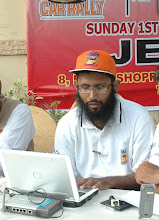
Height, Width, Direction Estimation ActivityShabbir Hazari | |
| This Activity is meant for Boy Scouts. Decide for yourself if it is appropriate for your younger scouts or not. | |
| Location: | This Activity should be done Outside. |
| Required: | 50 colored or numbered flags or markers of some kind. A lashed pole or climbable tree at least 30 feet high. 10 buckets. |
| Notes: | Review how to estimate heights and distances |
| 1. Distance Draw a starting line in an open field. Place the flags in a line perpendicular to the line with the first one about 20 feet from the line and each one 5 feet further out. Scouts asked to choose the flag color that is closest to 50 feet from the line. They could pace it out or you could add a rule that the can not step past the line. This would force them to use a method of measuring the width of a river. 2. Height Place markers on the pole about every foot. Stand the pole up. Or, climb a tree and place markers in it at height intervals. Scouts are asked to choose the marker that is at exactly 24 feet, or some specific height. You can give points for distance off target they are and the lowest score wins. 3. Direction Arrange markers in a circle about 50 feet across. Standing at a marked spot in the center, scouts are asked to choose the marker that is closest to NW or SE or some specific degree bearing. You can decide if a compass is allowed or if they need to tell direction by sun or stars. 4. Individual Reward Line the buckets up upside down in a line as in #1 above. Have all scouts stand next to the bucket they believe is exactly 42 feet from the starting line. If you placed treats under the correct bucket before hand, and maybe smaller treats under those close to it, they can see what they won when you tell them to look. | |
Monday, May 14, 2007
Height, Width, Direction Estimation Activity


Monday, April 30, 2007
Axemenship (or Axemanship) by Shabbir Hazari
IF you ever want to see how an axe should not be handled then it is an easy task. Just go along to just about any camp where you have a lot of troops or patrols and who are cooking over open fires. It's enough to make your blood run cold.
If you intend to allow your Scouts to handle an axe then please teach them how to handle it first. It is vital and there is no room for clowning around. It is very serious matter and probably the most dangerous piece of equipment in camp.
You should start by teaching the basics.
1. How to care an axe.
2. How to pass an axe from one person to another
3. Wood Chopping Area.
4. Axe safety.
5. Personal Safety.
6. How to chop
Collected by Shabbir Hazari (Shabbir Moiz Ali Hazari+92-302-8235252 shabbirhazari at gmail dot com)
If you intend to allow your Scouts to handle an axe then please teach them how to handle it first. It is vital and there is no room for clowning around. It is very serious matter and probably the most dangerous piece of equipment in camp.
You should start by teaching the basics.
1. How to care an axe.
2. How to pass an axe from one person to another
3. Wood Chopping Area.
4. Axe safety.
5. Personal Safety.
6. How to chop
|
| Safety MUST be paramount at all times. |
|
 |
|
 |
|
 |
|
 |
|
| Sharpening |
|
 |
|
 |
 |
|
 |
 |
Make sure that you have a firm footing. Always wear boots or strong shoes. Remove your scarf and other loose clothing. Always have a chopping block under the wood you are chopping. The part being cut must be resting on the block.
|
 |
|
 |
|
 |
Collected by Shabbir Hazari (Shabbir Moiz Ali Hazari+92-302-8235252 shabbirhazari at gmail dot com)
Saturday, April 28, 2007
SCOUTING IN PAKISTAN


SCOUTING IN PAKISTAN
PAKISTAN BOY SCOUTS ASSOCIATION
Article collected by Shabbir Moiz Ali Hazari
(0092-302-8235252 shabbirhazari @ gmail . com)
In the struggle for Better Scouting in Pakistan.
Scouting was officially founded in 1947, immediately after independence from the British and was recognized by the World Bureau (WOSM) in 1948. Membership in 1998 was 441,677.
Scouts have gained the respect of the citizens for their untiring work during floods where they have collected and distributed food and clothing. They have evacuated trapped people to safety and run first aid stations in refugee camps. They have been active in helping rebuild destroyed villages.
Scout program emphasis is on community service and conservation.
There is a program for handicapped Scouts supported by former Scouts in the Baden-Powell Guild.
src="http://pagead2.googlesyndication.com/pagead/show_ads.js">
Program Sections:

Scout Motto:
Almusta'ad……….Be Prepared
Scout Oath:
On my honour I promise that I will do my best, to do my duty to God and my country, to help other people at all times and to obey the Scout Law.
Mai waada karta hoon kay Allah Ta'allah, Mohammed Rasool-ul-Allah SAW aur Pakistan ki taraf say aa-eid karda taam faraiz ki adaigi, doosro ki imdad aur Scout qawaneen ki pabandi mai apni poori koshish karonga.
Scout and Rover Law:


Thursday, April 26, 2007
Scouting
Scouting, also known as the Scout Movement, is a worldwide youth movement with the stated aim of supporting young people in their physical, mental and spiritual development, so that they may play constructive roles in society.
Scouting began in 1907 when Robert Baden-Powell, Lieutenant General in the British Army, held the first Scouting encampment at Brownsea Island in England. Baden-Powell wrote the principles of Scouting in Scouting for Boys (London, 1908), based on his earlier military books, with influence and support of Seton of the Woodcraft Indians, Smith of the Boys' Brigade, and his publisher Pearson. During the first half of the 20th century, the movement grew to encompass three major age groups each for boys (Cub Scout, Boy Scout, Rover Scout) and for girls (Brownie Guide, Girl Guide and Girl Scout, Ranger Guide).
The movement employs the Scout method, a program of informal education with an emphasis on practical outdoor activities, including camping, woodcraft, aquatics, hiking, backpacking, and sports. Another widely recognized movement characteristic is the Scout uniform, by intent hiding all differences of social standing in a country and making for equality, with neckerchief and campaign hat or comparable head wear. Distinctive uniform insignia include the fleur-de-lis and the trefoil, as well as merit badges and other patches.
In 2007, Scouting and Guiding together have over 38 million members in 216 countries. The two largest umbrella organizations are the World Organization of the Scout Movement (WOSM), for boys-only and co-educational organizations, and the World Association of Girl Guides and Girl Scouts (WAGGGS), primarily for girls-only organizations but also accepting co-educational organizations.
2007 also marks the centenary of Scouting world wide, with member organizations planning events all over the world in order to celebrate this event.
History of Scouting
History
Origins

As a military officer, Baden-Powell was stationed in India and Africa in the 1880s and 1890s. Since his boyhood, he was fond of woodcraft and military scouting, and therefore – as part of their training – showed his men how to survive in the wilderness. He noticed it taught the soldiers to develop independence, rather than just blindly follow officers' orders.[1]
In South Africa in the Second Boer War, Baden-Powell got besieged in the small town Mafeking against a much larger Boer army (the Siege of Mafeking).[2] The Mafeking Cadet Corps was a group of youths that supported the troops by carrying messages, which freed the men for military duties and kept the boys occupied during the long siege. The Cadet Corps performed well, helping in the defense of the town (1899–1900), and were one of the many factors that inspired Baden-Powell to form the Scouting movement.[3][4][5] Each member received a badge that illustrated a combined compass point and spearhead. The badge's logo was similar to the fleur-de-lis that Scouting later adopted as its international symbol. In the United Kingdom the public followed his struggle to hold Mafeking through newspapers, and when the siege was broken Baden-Powell had become a national hero. This pushed the sales of a small instruction book he had written about military scouting, Aids to Scouting. On his return to England he noticed the large interest of boys in this book, which was also used by teachers and youth organizations.[6] He was suggested by several to rewrite this book for boys, especially during an inspection of the Boys' Brigade. This brigade was a large youth movement, drilled with military precision. Baden-Powell thought this would not be attractive and suggested that it could grow much larger when scouting would be used.[7] He studied other schemes, parts of which he used for Scouting.
In July 1906, Ernest Thompson Seton sent Baden-Powell a copy of his book The Birchbark Roll of the Woodcraft Indians. Seton, a British-born Canadian living in the United States, met Baden-Powell in October 1906, and they shared ideas about youth training programs.[8][9][10] In 1907 Baden-Powell wrote a draft called Boy Patrols. In the same year, to test his ideas, he gathered 21 boys of mixed social backgrounds and held a week-long camp in August on Brownsea Island in Poole Harbour, Dorset, England.[11] His organizational method, now known as the Patrol System and a key part of Scouting training, allowed the boys to organize themselves into small groups with an elected patrol leader.[12]
In the autumn of 1907, Baden-Powell went on an extensive speaking tour arranged by his publisher, Arthur Pearson, to promote his forthcoming book, Scouting for Boys. He had not simply rewritten his Aids to Scouting, but left out the military aspects and transferred the techniques (mainly survival) to non-military heroes: backwoodsmen, explorers (and later on, sailors and airmen).[1] He also added innovative educational principles (the Scout method) by which he extended the attractive game to a personal mental education.
Scouting for Boys first appeared in England in January 1908 as six fortnightly installments, and was published in England later in 1908 in book form. The book is now the fourth-bestselling title of all time,[13] and is now commonly considered the first version of the Boy Scout Handbook.[14]
At the time, Baden-Powell intended that the scheme would be used by established organizations, in particular the Boys' Brigade, from the founder William A. Smith.[15] However, because of the popularity of his person and the adventurous outdoor game he wrote about, boys spontaneously formed Scout patrols and flooded Baden-Powell with requests for assistance. He encouraged them, and the Scouting movement developed momentum. As the movement grew, Sea Scout, Air Scout, and other specialized units were added to the program.
Subscribe to:
Posts (Atom)

 Posts
Posts